
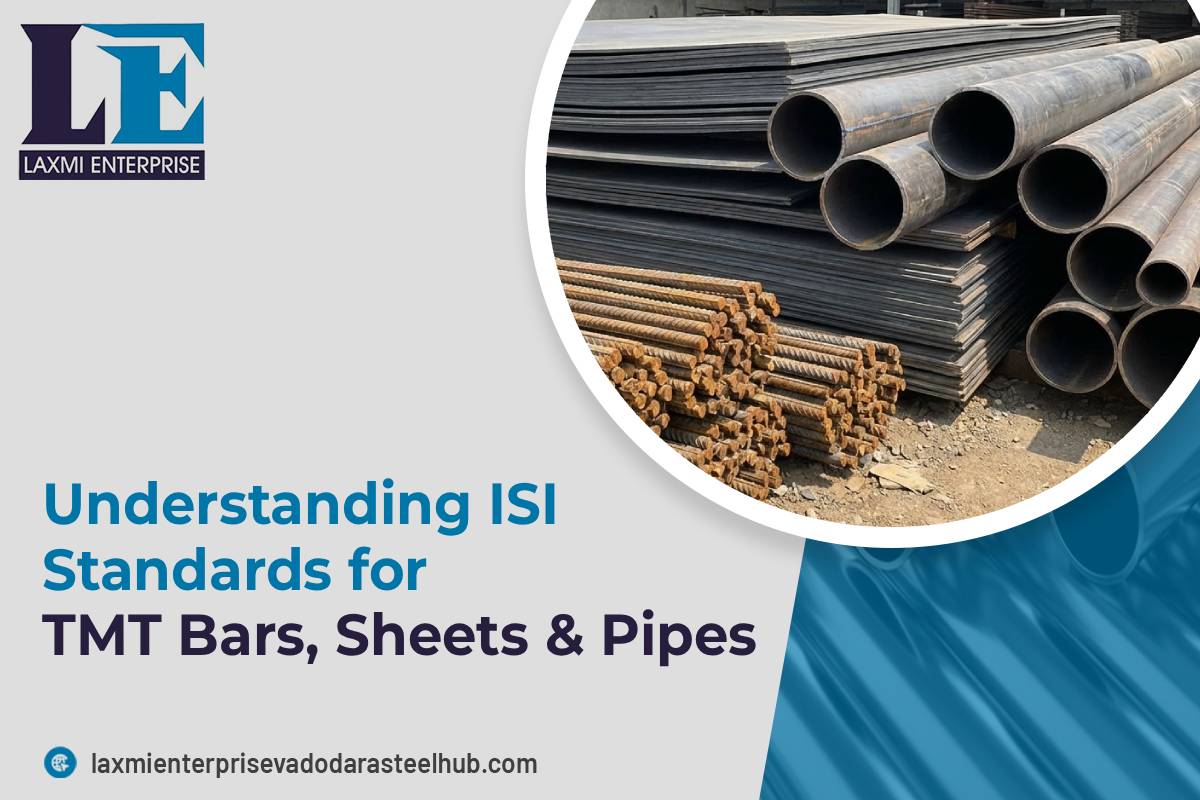
ISI standards, which are currently managed by the Bureau of Indian Standards (BIS), are essential to preserving the long-term performance, quality, and safety of building materials in India. These standards specify everything from dimensions and durability to chemical composition and strength for TMT bars, steel sheets, and pipes.
Adhering to BIS standards contributes to the safety, dependability, and regulatory compliance of structures. In this blog, we will understand the ISI standard for TMT bars, sheets & pipes. Laxmi Enterprise is a trusted MS TMT bar supplier in Vadodara, providing the highest quality mild steel TMT bars and MS pipes sourced from top manufacturers. With this blog, we aim to help readers understand ISI Standards for TMT bars, sheets and pipes, to make informed decisions for their projects.
Let’s Take a Look at ISI Standards for Popular Steel Products
#1 TMT Bar ISI Standards (IS 1786:2008)
IS 1786:2008 outlines specifications for high-strength deformed steel bars used in reinforced concrete, which is the benchmark standard for Thermo-Mechanically Treated (TMT) bars.
- Strength and Grades: Fe 415, Fe 500, Fe 550, and Fe 600 are common grades, where the number denotes the minimum yield strength (MPa).
- Variants of the “D” Grade: Better elongation and increased ductility are provided by grades like Fe 500D and Fe 550D. These bars are perfect for seismically active areas because they have less phosphorus and sulfur.
Essential Technical Conditions
- Chemical Composition: Strict restrictions on phosphorus, sulfur, and carbon to increase corrosion resistance and weldability.
- Rib Pattern: Robust bonding with concrete is ensured by well-defined and consistent ribs.
- Bend and Re-bend Tests: To ensure flexibility and structural safety, bars must bend without cracking.
Verification of ISI Marks
- Genuine TMT bars are directly embossed with the grade, manufacturer’s logo, and the ISI mark (IS 1786).
#2 ISI Standards for Steel Sheets and Plates
Steel sheets and plates used in construction and engineering must meet the BIS standards related to strength, thickness, and surface protection.
- Structural Steel (IS 2062): For hot-rolled medium and high-tensile steel plates and sheets.
- Galvanized Steel Sheets (IS 277): Covers zinc-coated steel used for corrosion resistance.
- Dimensions Standard (IS 1730): Specifies standard sizes for plates, sheets, and strips.
- Stainless Steel (IS 6911): Applies to stainless steel plates, sheets, and strips for engineering applications.
#3 ISI Standards for Pipes and Tubes
Steel pipes and tubes are regulated based on how and where they are used, such as in manufacturing steel frameworks, water supply, and gas transport.
- Structural Pipes (IS 1161): Used for welded or seamless steel tubes used in structural applications.
- General Purpose Pipes (IS 1239 ): Covers mild steel pipes and fittings for general use.
- Hollow Sections (IS 4923): Ensures accurate thickness and shape for square and rectangular hollow sections (SHS/RHS).
- Stainless Steel Tubes (IS 6527): Applies to stainless steel tubes and wire rods.
Factors to Consider Before Purchasing a Steel Article
| Key Aspect | What It Means | Why It Matters |
|---|---|---|
| QCO Compliance (2024–2025) | BIS Quality Control Orders make ISI certification mandatory for steel manufacturers | Ensures only quality-approved steel is sold, reducing the risk of substandard materials |
| ISI/BIS Markings | The product must carry the embossed ISI/BIS mark, grade, and manufacturer’s identification | Confirms authenticity and compliance with Indian standards |
| Mill Test Certificate (MTC) | A batch-wise certificate detailing chemical composition and mechanical properties | Verifies the strength, ductility, and overall quality of the steel |
| Grade Verification | Confirms the steel grade (e.g., Fe 500, Fe 500D) matches project requirements | Ensures suitability for structural load and seismic safety |
| Source Reliability | Purchasing from authorized dealers or reputed manufacturers | Minimizes the risk of counterfeit or uncertified steel |
| Seismic Safety | Preference for ductile “D” grade steel in earthquake-prone zones | Improves structural flexibility and reduces failure risk |
| Avoid Non-ISI Materials | Do not use steel without a valid ISI certification | Prevents structural failures and legal or safety issues |
Conclusion
Choosing ISI-certified steel goes beyond simply meeting regulations. It’s about building with confidence. BIS standards guarantee that the steel you use has the right strength, flexibility, and quality to endure over time. With quality control orders now in effect, it’s crucial to check ISI markings, confirm grades, and request mill test certificates before buying. These simple checks can avoid significant issues later, especially in areas prone to earthquakes. Choose Laxmi Enterprise, the most trusted supplier of MS steel product in Vadodara. By opting for certified steel from reliable sources, you safeguard your structure, your investment, and the people who depend on it every day. Give us a call to know more.
Also Check: MT Bars vs. Traditional Steel Bars
Frequently Asked Questions (FAQs)
ISI certification ensures that steel meets BIS standards for strength, safety, and durability. It confirms that the material has been tested for proper chemical composition and mechanical performance, reducing the risk of structural failures.
Look for the embossed ISI/BIS mark, the steel grade, and the manufacturer’s identification on the product. You should also ask for a mill test certificate (MTC) to verify batch-wise quality.
Yes. Under BIS Quality Control Orders, ISI certification is mandatory for many steel products, helping eliminate substandard materials from the market and ensuring safer construction.