
A TMT bar delivery usually arrives when the site is busy. The truck is at the gate, the driver wants to unload quickly and the labour team is waiting to start work. In this rush, most site teams accept the load without checking it properly. The problem is that once the bars are unloaded and mixed with old stock, it becomes very difficult to raise a complaint.
Wrong grade, underweight bars, heavy rust or a short bundle count can all go unnoticed until it is too late. A quick quality check at the site takes less than 30 minutes and can save you from costly mistakes later. In this blog, Laxmi Enterprise share 8 simple checks that every builder, contractor and site engineer should follow before accepting a TMT bar load.
Why Checking TMT Bars at Site Is Important
TMT bars carry the main tension load in slabs, beams, columns and foundations. If the steel is weak, the structure may look fine at first but can develop cracks or other problems over time. Since TMT bars are sold by weight, an underweight load also means you pay for steel you never received. This is why it is always better to buy from a trusted TMT bar supplier in Vadodara and still check every load before unloading.
8 Simple Checks Before You Accept a TMT Bar Load
1. Match the Documents with Your Order
Start with the paperwork before you look at the steel. Ask for the tax invoice, delivery challan and Mill Test Certificate (MTC). Compare the brand, grade, bar sizes, number of bundles and total weight with your purchase order. The heat number on the MTC should also match the tag on the bundles. If the papers say Fe 500D but the bundle tags say something else, stop the unloading and speak to the supplier.
2. Look for the ISI Mark and Grade Marking
Genuine TMT bars are made as per IS 1786 and carry markings rolled on the bar itself. Check a few bars from different bundles for the brand name or logo, ISI mark and grade such as Fe 500 or Fe 500D. These markings are raised and part of the bar. If they look painted, stamped later or are missing on some bars, the load needs a closer look.
3. Measure the Bar Diameter
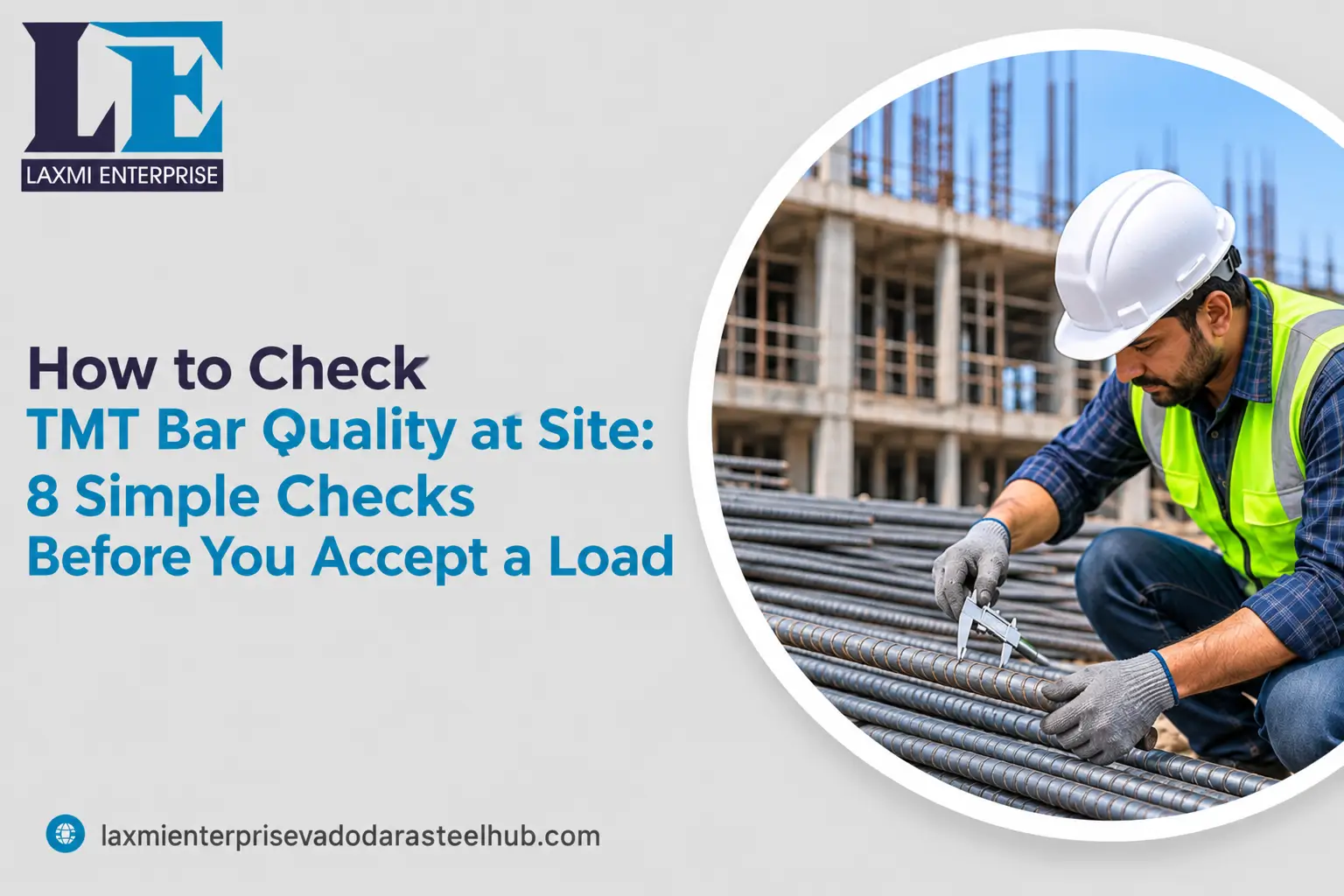
Use a vernier caliper to measure a few bars of each size. Take readings at two or three points along the bar. Since TMT bars have ribs, measure both across the ribs and between them. A 12 mm bar should clearly measure like a 12 mm bar, not something smaller.
4. Weigh a Sample Piece
This is the most useful check at the site. Cut a 1 metre piece and weigh it. The standard weight of a TMT bar can be worked out with a simple formula: diameter × diameter ÷ 162. For example, a 12 mm bar should weigh about 0.888 kg per metre and a 16 mm bar about 1.58 kg per metre. A small difference is allowed as per IS 1786, but if every sample comes out light, the whole load is underweight.
5. Check the Rib Pattern
Ribs help the bar grip the concrete firmly. Look along the length of a few bars and check that the ribs are even in height, evenly spaced and present along the full length. Bars from the same brand in one load should have the same rib pattern. Mixed patterns in one bundle can mean the steel has come from different sources.
6. Inspect the Surface for Rust and Defects
A thin layer of light brown rust is normal for steel stored in open air and does not affect its strength. What you should not accept is heavy, flaky rust, small pits on the surface, cracks or thin lines where the metal looks folded. Scrape a bar with a wire brush. If clean steel shows underneath, the bar is fine. If the surface looks eaten or uneven, set that bundle aside.
7. Verify Length, Count and Straightness
Standard TMT bars come in 12 metre lengths unless you have ordered cut lengths. Measure a few bars with a tape, count the bars in a bundle and match the count with the bundle tag. Also check that the bars are reasonably straight. Badly bent bars are difficult to cut and bend accurately on site.
8. Do a Simple Bend Test
Take a short spare piece and bend it into a tight U shape using a bar bending machine. Then check the outer side of the bend. A good quality bar will bend smoothly without any cracks. If you see cracks or the bar breaks, send samples to a testing lab before using that batch. This check is very important in Gujarat, as many parts of the state fall in higher seismic zones where ductile steel like Fe 500D is preferred.
Red Flags That Mean You Should Stop Unloading
- No MTC or a heat number that does not match the bundle tags
- Grade on the bars is different from the invoice
- Every sample weighs less than the standard weight
- Missing or painted-on markings
- Heavy rust, pitting or cracks on many bars
- Supplier refuses to allow a sample check
Always take photos of the bundle tag, the weighing scale reading and any defect before calling the supplier. This makes it much easier to settle the issue.
Conclusion
Checking TMT bars at the site is a small step that protects both the strength of your structure and your money. Matching the documents, checking the markings, weighing a sample and doing a simple bend test can help you catch most quality problems before the steel goes into your project. Once the load is accepted, store the bars on a raised platform, keep different sizes separate and cover them during the monsoon.
At Laxmi Enterprise, we have been supplying steel in Vadodara since 1998 and are an authorised dealer of Tata Steel since 2016. As a leading name for TMT bar wholesale in Vadodara, we supply genuine TMT bars with proper Mill Test Certificates, correct bundle tags and full weight for residential, commercial and industrial projects. Along with TMT bars, we are a complete MS steel supplier in Vadodara for pipes, beams, channels, angles, plates and sheets. To place an order or get a quote, call us today.
Frequently Asked Questions (FAQs)
You can match the documents with your order, check the ISI mark and grade on the bar, measure the diameter, weigh a 1 metre sample, check the ribs and surface, and do a simple bend test on a spare piece. These checks can catch most common quality issues.
- A 12 mm TMT bar weighs about 0.888 kg per metre. A full 12 metre bar weighs about 10.66 kg.
Use the formula diameter × diameter ÷ 162. The answer is the weight in kg per metre. For example, for a 10 mm bar, 10 × 10 ÷ 162 = 0.617 kg per metre.
Yes. A thin layer of light rust that comes off easily is normal and does not affect the bond with concrete. Heavy, flaky rust, pitting or cracks are not acceptable.
Both have a minimum yield strength of 500 N/mm². Fe 500D has better ductility because of lower carbon, sulphur and phosphorus content, so it bends more without cracking. This makes it better suited for earthquake-prone areas.
TMT bars in India are manufactured as per IS 1786, which covers high strength deformed steel bars used for concrete reinforcement.
Stop unloading, take photos of the bundle tag and the defect, and inform your supplier right away. If needed, send samples to an approved testing lab before using the material.
Always buy from an authorised dealer that provides a Mill Test Certificate and allows checks at delivery. Laxmi Enterprise is one of the trusted TMT bars wholesale dealers in Vadodara and an authorised Tata Steel dealer.