
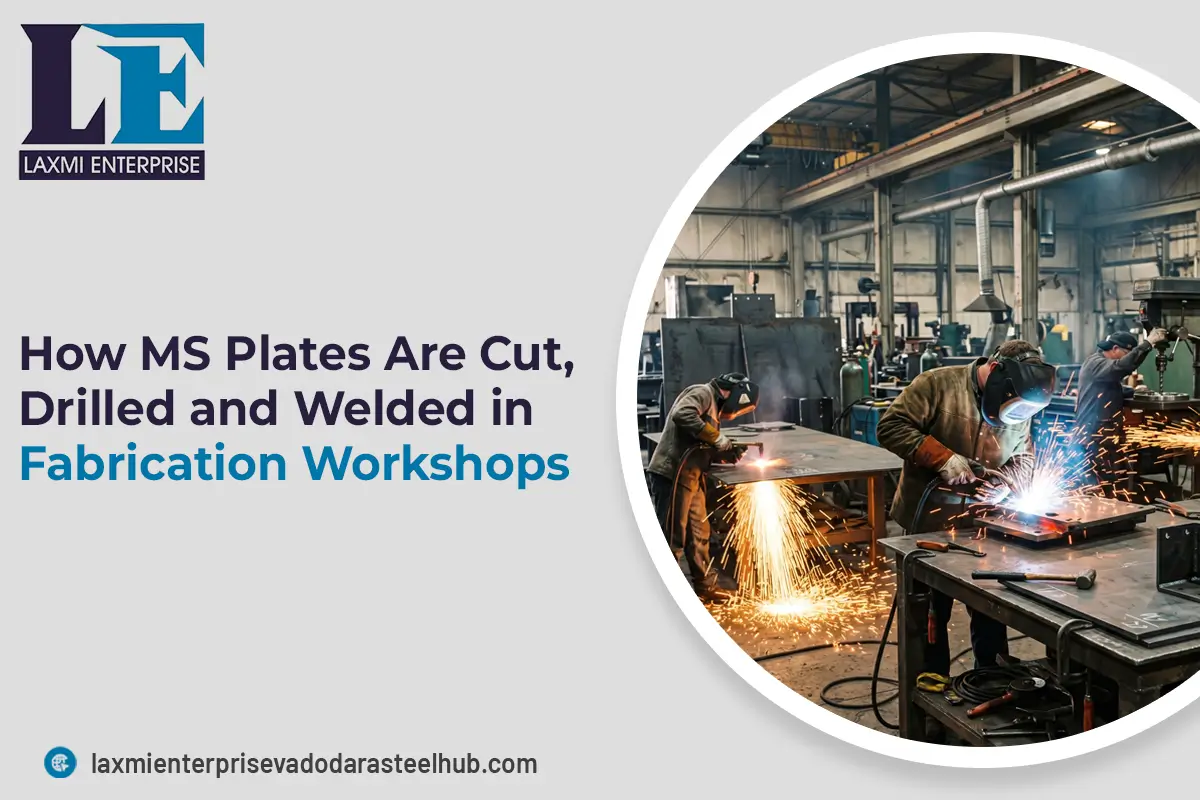
Mild steel plates are one of the most versatile raw materials in fabrication. Whether it’s a machine base, a storage tank, a structural gusset, or a heavy-duty conveyor frame, MS plates form the backbone of hundreds of industrial and construction applications. But the raw plate that arrives from the rolling mill is only the beginning. What happens in the fabrication workshop, how the plate is cut to shape, drilled for fasteners, and joined to other components, determines whether the finished structure performs for decades or fails prematurely.
With this guide, we at Laxmi Enterprise, a leading MS steel supplier in Vadodara, walk you through each of those three stages in practical detail: the tools, the techniques, and the things that actually matter on the shop floor.
3 Stages of Cutting MS Plates: From Raw Sheets to Precise Shapes
Stage 1: Cutting
Cutting is almost always the first operation. A fabricator needs to take a standard plate, typically supplied in 2500 × 1250 mm or 3000 × 1500 mm sheets, and reduce it to the geometry required by the job. The choice of cutting method depends on plate thickness, required edge quality, volume, and whether the cut profile is straight or complex.
One factor fabricators often underestimate is the heat-affected zone (HAZ), the region of metal adjacent to a thermal cut where the microstructure has been altered by rapid heating and cooling. In thicker plates or higher-carbon steels, this zone can become harder and more brittle than the parent metal. For structurally critical joints, HAZ-affected edges should be ground or machined back before welding to restore ductility.
Stage 2: Drilling
Holes in MS plates serve three primary purposes in fabrication: bolt connections, pipe or cable pass-throughs, and weight reduction in non-critical zones. In structural work, the accuracy of hole placement is critical. A bolt hole that’s 2 mm out of position can make it impossible to align mating components, wasting a plate that may have cost thousands of rupees.
Stage 3: Welding
Welding is where cut and drilled components become a structure. For MS plates, the four most commonly encountered welding processes in Indian fabrication workshops are shielded weld arc welding, gas metal arc welding, gas tungsten arc welding and submerged arc welding.
MS Plates Grades and How They Affect Fabrication
- IS 2062 E250: General structural use. Lowest carbon content, most weldable, most forgiving in fabrication. The default choice for brackets, frames, and general structural work.
- IS 2062 E350: Higher yield strength. Used where load demands are greater, such as crane girders, heavy frames, and pressure-bearing structures. Requires slightly more care in welding (pre-heat above ~20 mm).
- IS 2062 E410: High-strength structural grade. For demanding applications like bridges and heavy equipment. Needs proper welding procedure specification (WPS) and qualified welders.
- Chequered HR Plate: Hot-rolled chequered plates with a raised pattern for grip, like walkways, platforms, and floors. Fabricated by the same processes, the pattern face must be considered in clamping and fit-up.
Need MS Plates for Your Fabrication Project?
Laxmi Enterprise is a leading mild steel plate supplier in Vadodara, offering a full range of MS plates of thickness, grades and sizes. To request quotes, call us today.