MS Steel

Categories
MS Steel

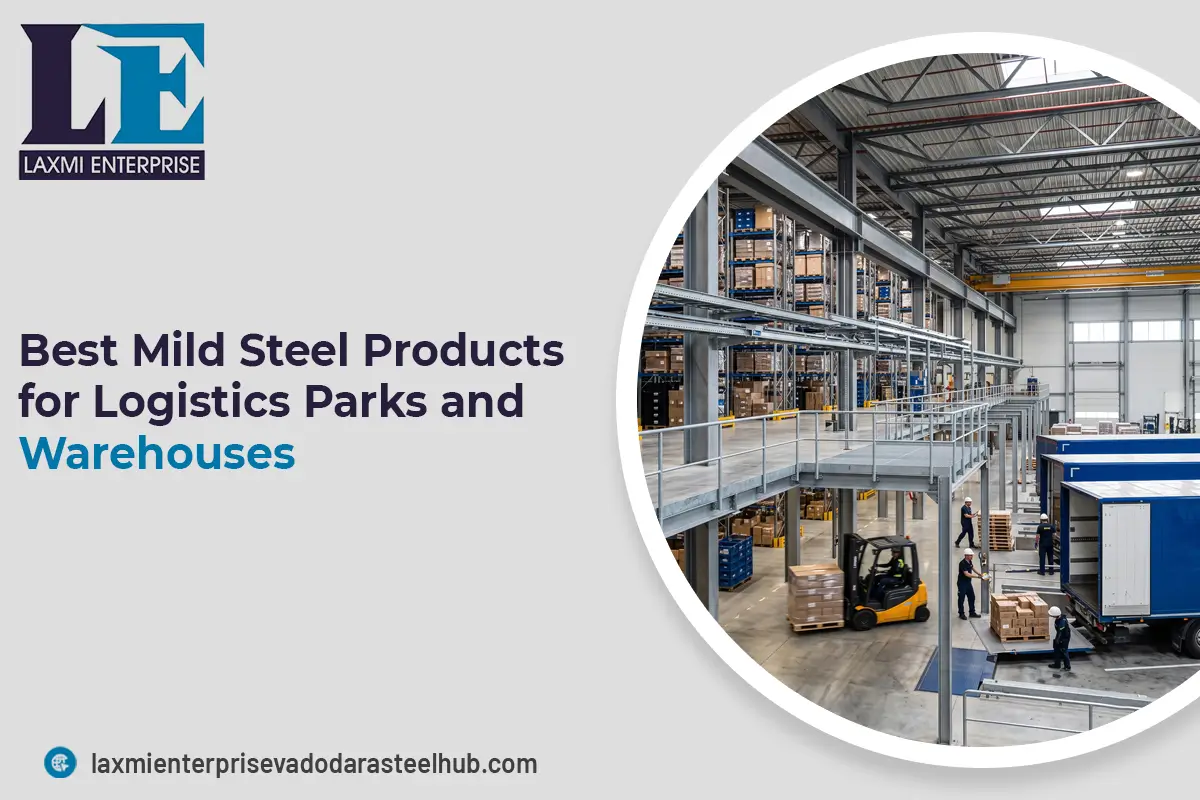
Best Mild Steel Products for Logistics Parks and Warehouses

Building a strong and reliable warehouse starts with choosing the right steel products. Logistics parks and warehouses need durable structures, strong flooring, wide loading areas, and storage systems that can handle heavy loads and daily use. Mild steel (MS steel) is widely used in these applications because it is strong, easy to fabricate, and available in different sizes and shapes.

Warehousing is growing across Gujarat, including the Vadodara region. As more warehouses and logistics facilities are being developed, builders, contractors, PEB companies, and project developers need quality steel products that meet their requirements and arrive on time.

Laxmi Enterprise supplies a wide range of steel products for warehouse and logistics projects. In this guide, we will explain the most commonly used mild steel products in warehouses and logistics parks, their applications, and the important factors to consider before purchasing them.

Why Mild Steel Is Used in Warehouses

Mild steel is a popular choice for warehouse construction because it offers a good combination of strength, flexibility, and cost. It can be used for building structures, storage systems, and other parts of a warehouse that need to handle regular loads and heavy use.

Here are the main reasons why mild steel is widely used in warehouses and logistics parks:

  • Strong and cost-effective: Mild steel can support heavy loads while keeping construction costs manageable. This makes it a practical option for large warehouse projects.
  • Easy to cut and fabricate: MS steel can be cut, drilled, bent, and welded into different shapes and sizes. This makes fabrication easier and helps meet specific project requirements.
  • Faster construction: Steel components can be prepared in advance and assembled at the site. This can help reduce construction time and allow the warehouse to become operational sooner.
  • Suitable for large open spaces: Steel structures can be designed to create wide, open areas with fewer columns. This gives trucks, forklifts, and storage racks more room to move and operate.
  • Easy to expand: If the warehouse needs more space in the future, steel structures can often be extended by adding new bays or sections, depending on the original design.
  • Recyclable material: Steel can be recycled at the end of its service life, making it a useful material for projects that consider long-term resource efficiency.

Best Mild Steel Products for Logistics Parks and Warehouses

A warehouse or logistics park requires different types of steel products for its structure, roofing, flooring, storage systems, and supporting facilities. Choosing the right product helps ensure that the project is strong, safe, and built according to its design requirements.

From MS beams and channels to steel plates, pipes, TMT bars, and roofing sheets, each product has a specific role in warehouse construction. The right choice depends on factors such as load capacity, dimensions, material grade, and how the steel will be used.

Here are the key mild steel products commonly used in logistics parks and warehouses.

1. MS Beams (ISMB)

MS beams are steel sections with an I-shaped profile. They are used in structures that need to support significant loads and transfer those loads safely to the columns and foundations.

Where are MS beams used?

  • Main columns and rafters in conventional steel structures
  • Mezzanine floor framing
  • Crane runway supports
  • Loading dock canopy structures

What should you check before buying?

Select the beam size according to the structural drawing and expected load. Check the beam’s depth, weight per metre, and required material grade. In India, IS 2062 is commonly used for structural steel material specifications, while IS 808 covers dimensions for hot-rolled steel sections.

The correct beam size should always be confirmed by the structural engineer.

For warehouse projects, buyers looking for a mild steel beam supplier in Vadodara can check the available sizes and specifications from Laxmi Enterprise.

2. MS Channels (ISMC)

MS channels have a C-shaped profile and are used in a wide range of structural and fabrication applications. They are suitable for supporting secondary members and creating different types of steel frames.

Where are MS channels used?

  • Purlins and side girts for roof and wall support
  • Secondary framing and bracing
  • Machine and conveyor base frames
  • Loading dock and door frame structures

What should you check before buying?

The channel size should match the span, load, and structural details provided in the drawing. Confirm the channel dimensions, thickness, and weight to ensure that the selected product meets the project requirements.

Laxmi Enterprise supplies MS channels for different structural and fabrication requirements, making it a suitable option when looking for an ISMC C channel supplier in Vadodara.

3. MS Angles (ISMA)

MS angles are L-shaped steel sections used in structural work, fabrication, and support applications. They are a practical choice for projects that require bracing, connections, and lightweight steel frames.

Where are MS angles used?

  • Roof trusses
  • Cross bracing between columns
  • Cleats and structural connections
  • Shelf and rack frames
  • Edge protection for floors and platforms

What should you check before buying?

MS angles are available in equal and unequal leg sizes. Before placing an order, check the leg dimensions, thickness, length, and material grade. Choose the size according to the design and the intended application.

For warehouse and fabrication requirements, Laxmi Enterprise supplies MS angles for buyers looking for an MS angle supplier in Vadodara.

4. MS Pipes and Hollow Sections

MS pipes are available in different shapes, including square pipes and rectangular pipes. Hollow sections are useful for applications that need a suitable balance of strength, weight, and ease of fabrication.

Where are MS pipes and hollow sections used?

  • Tubular roof trusses
  • Columns for canopies and parking sheds
  • Handrails, staircases, and walkways
  • Safety bollards and rack protectors
  • Boundary fencing and gates

What should you check before buying?

Check the outside dimensions, wall thickness, length, and applicable product standard. IS 1239 and IS 4923 are relevant standards for different pipe and hollow-section applications, so the correct standard should be selected based on the product type.

Laxmi Enterprise supplies Tata Structura hollow sections and Tata pipes for suitable construction and fabrication requirements. Buyers looking for a mild steel pipes supplier in Vadodara can check the available products.

5. Roofing Sheets and Colour Coated Sheets

A warehouse roof covers a large area and must provide protection from weather conditions such as rain, sunlight, and dust. Roofing sheets and colour coated sheets are commonly used for roofing and wall cladding.

Where are roofing sheets used?

  • Warehouse roof cladding
  • Side wall cladding
  • Loading bay canopies
  • Partition walls and site offices

What should you check before buying?

Pay attention to the base metal thickness, coating type, coating mass, and profile of the sheet. These factors influence the sheet’s suitability, durability, and resistance to corrosion.

For warehouse roofing requirements, Laxmi Enterprise supplies colour coated profile roofing sheet in Vadodara along with other roofing products.

GC sheets may be suitable for certain budget-conscious applications, including temporary sheds and site structures, depending on the project requirements and expected service life.

6. MS Plates and Chequered Plates

MS plates are flat steel products available in different thicknesses and sizes. They are used for structural connections, support components, and fabrication work.

Chequered plates have a raised surface pattern that can improve traction in suitable flooring and access applications.

Where are MS plates and chequered plates used?

  • Column base plates
  • Gusset plates and connection plates
  • Loading ramps and dock-related structures
  • Mezzanine flooring and walkways
  • Stair treads and working platforms

What should you check before buying?

Confirm the required plate thickness, width, length, and material grade. For chequered plates, check the surface pattern and dimensions to ensure they are appropriate for the intended use.

The plate specifications should be selected based on the structural design and the working conditions of the application.

Laxmi Enterprise supplies MS plates for warehouse construction and fabrication requirements for buyers looking for an MS plate supplier in Vadodara.

7. MS TMT Bars

A warehouse project does not rely only on its steel frame. Concrete foundations, floor slabs, retaining walls, and other structures also require reinforcement. MS TMT bars are used to strengthen reinforced concrete and help it withstand the loads for which it is designed.

Where are TMT bars used?

  • Column foundations and footings
  • Warehouse floor slabs
  • Retaining walls and boundary walls
  • Internal roads and truck parking areas
  • Office buildings within a logistics park

What should you check before buying?

TMT bars in India are commonly manufactured according to IS 1786. Grades such as Fe 500, Fe 500D, and Fe 550D are used for different reinforcement requirements.

The grade and diameter should be selected according to the structural engineer’s specifications. Do not choose the reinforcement grade only on the basis of price or availability.

Laxmi Enterprise is an authorised dealer of Tata Steel and supplies Tata Tiscon TMT bars. For project requirements, buyers can contact a TMT bar supplier in Vadodara.

8. MS Flat Bars

MS flat bars are long, flat steel sections used in fabrication, structural support, and other general engineering applications. Their simple shape makes them useful for creating brackets, frames, and reinforcing components.

Where are MS flat bars used?

  • Bracing straps and stiffeners
  • Gate and grill frames
  • Brackets and support components
  • Earthing strips, including suitable galvanised flat bars

What should you check before buying?

Confirm the required width, thickness, and length. For earthing applications, verify the material and finish requirements specified by the electrical or project engineer.

Laxmi Enterprise supplies flat bars for different fabrication and construction applications as a flat bar supplier in Vadodara.

9. HR and CR Sheets

HR sheets and CR sheets are flat steel products used in fabrication, manufacturing, and various warehouse-related applications.

HR stands for hot rolled, while CR stands for cold rolled. The manufacturing process gives these products different surface characteristics and suitability for specific uses.

Where are HR and CR sheets used?

  • Rolling shutters and doors
  • Ducting and protective covers
  • Storage cabinets and lockers
  • Fabricated components and small enclosures

What should you check before buying?

Choose the sheet type based on the application, required thickness, surface finish, and fabrication process.

HR sheets are commonly used for applications where general fabrication and structural requirements are important. CR sheets are often preferred where a smoother surface and better dimensional finish are needed.

Before purchasing, confirm the required thickness, grade, dimensions, and finish with the supplier.

For CR sheet requirements, buyers can contact Laxmi Enterprise as a CR sheet supplier in Vadodara.

Which Steel Products Are Used in Different Warehouse Areas?

Warehouse Area

Recommended MS Steel Products

Main structure (columns and rafters)

MS Beams, MS Pipes / Hollow Sections

Roof trusses

MS Angles, MS Pipes

Purlins and side girts

MS Channels

Roof and wall cladding

Roofing Sheets, Colour Coated Sheets

Foundations and floor slabs

TMT Bars

Mezzanine floors

MS Beams, MS Channels, Chequered Plates

Loading docks and ramps

MS Plates, Chequered Plates, MS Angles

Racking and storage frames

MS Angles, MS Channels, Hollow Sections

Safety bollards and handrails

MS Pipes

Gates and fencing

MS Pipes, MS Flat Bars, MS Angles

Shutters, ducts, and cabinets

HR Sheets, CR Sheets

How to Choose the Right MS Steel for Your Warehouse

  1. Follow the structural drawing. Always buy steel according to the size and grade specified by your structural engineer. Do not use a lighter section just to reduce costs.
  2. Check the grade and standard. Ask for the correct grade, such as E250 as per IS 2062 for structural sections or Fe 500D as per IS 1786 for TMT bars.
  3. Ask for a Mill Test Certificate. A test certificate shows the chemical and mechanical properties of the steel. Read our guide on how to read a Mill Test Certificate to know what to check.
  4. Plan for rust protection. Warehouses in coastal or humid areas need proper protection. Use coated roofing sheets and paint or galvanise exposed steel.
  5. Order in the right lengths. Ordering the right lengths helps reduce waste and saves fabrication time. Discuss the required lengths with your supplier before placing the order.
  6. Plan deliveries by stage. A warehouse is built in stages: foundation, frame, roof, and finishing. Plan steel deliveries according to each stage so the site does not get crowded with excess material.
  7. Buy from one reliable supplier. Buying beams, channels, pipes, sheets, and TMT bars from one supplier can make ordering, billing, and quality checks easier.

Why Buy Warehouse Steel from Laxmi Enterprise

Laxmi Enterprise has been supplying MS steel in Vadodara since 1998, with over 25 years of experience in the steel industry. We became an authorised dealer of Tata Steel in 2016.

  • Full range in one place: MS beams, channels, angles, pipes, hollow sections, plates, chequered plates, flat bars, HR and CR sheets, roofing sheets, and TMT bars.
  • Trusted brands: Tata Structura, Tata Pipes, Tata Tiscon, Tata Astrum, Tata Shaktee, Durashine, Jindal, Vizag Steel, and more.
  • Experience with project buyers: We supply steel to manufacturing companies, PEB companies, builders, and architects.
  • Standard sizes with custom lengths: Material is available in standard sizes, with options for custom lengths and finishes.
  • Timely delivery: We understand that steel delays can hold up construction work.

Conclusion

Choosing the right MS steel products is important for building a strong and reliable warehouse. From beams, channels, and angles to pipes, plates, roofing sheets, and TMT bars, each product has a specific role in the project. Laxmi Enterprise provides a wide range of steel products for warehouse, logistics park, and industrial construction requirements in Vadodara.

Frequently Asked Questions (FAQs)

The main products include MS beams, MS channels, MS angles, MS pipes and hollow sections, roofing sheets, MS plates, chequered plates, TMT bars, and MS flat bars. Each product is used for a different part of the building.

Yes. Mild steel is strong, easy to weld and fabricate, and supports fast construction with wide open spaces. It is commonly used for warehouse and industrial shed frames.

Warehouse roofs generally use colour coated or coated roofing sheets fixed on MS channel or Z/C purlins, with trusses made from MS angles or pipes.

A PEB (pre-engineered building) uses members designed and fabricated in a factory to specific sizes. A conventional steel warehouse uses standard rolled sections such as ISMB beams, ISMC channels, and ISMA angles, fabricated as per the design. Both use mild steel.

Fe 500 and Fe 500D are commonly used grades. The correct grade and bar size depend on the floor load and should be selected by your structural engineer.
Categories
MS Steel

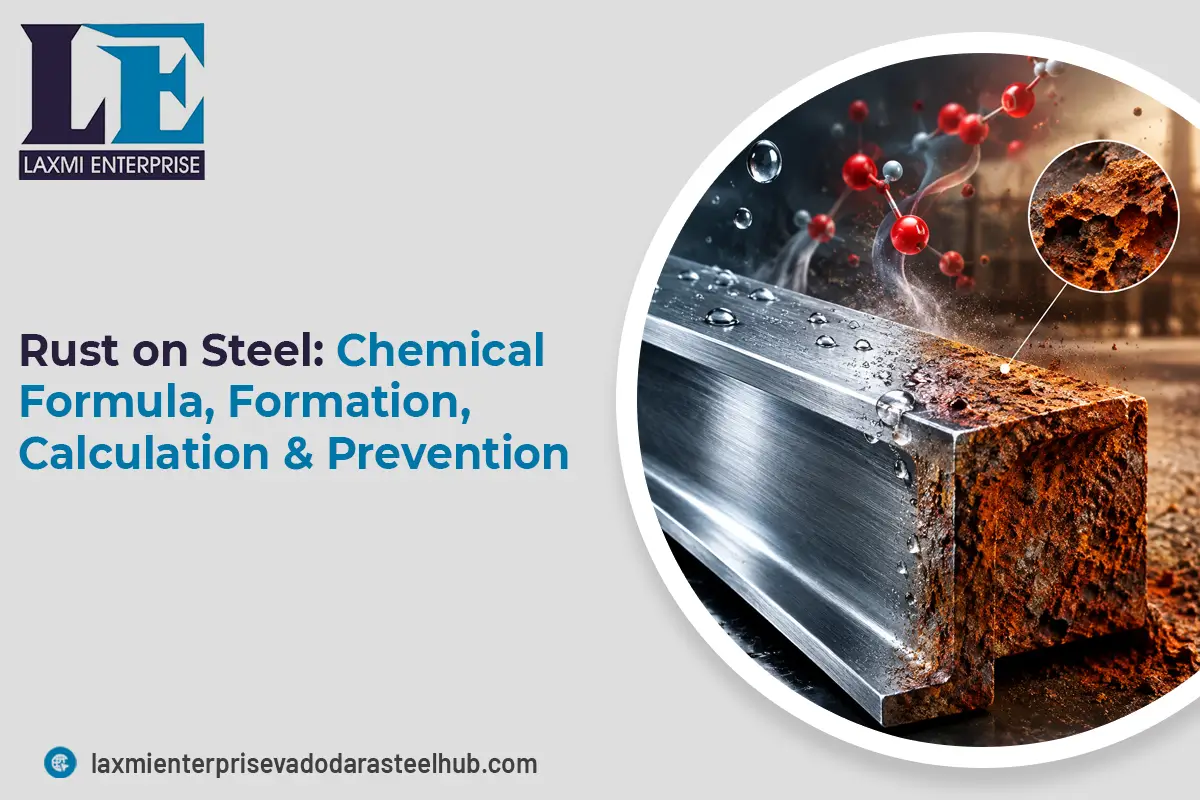
Rust on Steel: Maintenance, Calculation & Prevention

Rust on steel is a common problem in construction, fabrication, and industrial applications. It can weaken steel, damage its surface, and reduce the service life of structures and machines. The good news is that rust is easy to understand and, in most cases, can be controlled.

This guide explains what rust is, how it forms, how to calculate rust and corrosion rates, and how to prevent rust on mild steel.

What Is Rust?

Rust is the reddish-brown layer that forms on iron and steel when they react with oxygen and water. In simple words, rust is iron oxide mixed with water.

Rust is a type of corrosion. Corrosion is the general term for a metal slowly breaking down because of a reaction with its surroundings. When iron or steel corrodes, the product is called rust. Other metals like copper and aluminium also corrode, but their corrosion is not called rust.

Mild steel is mostly iron with a small amount of carbon. Because it contains mostly iron, it can rust when left unprotected. Stainless steel rusts much less because it contains chromium, which forms a thin protective layer on the surface.

How Does Rust Form on Steel?

Rust needs three things:

  1. Iron — from the steel
  2. Oxygen — from the air
  3. Water — moisture, rain, humidity, or condensation

If any one of these is missing, rust will not form. For example, steel kept in completely dry air rusts very slowly.

Rusting is an electrochemical process. A drop of water on the steel surface acts like a small battery. One area of the steel loses electrons, while another area uses those electrons.

In simple words:

Iron + oxygen + water → rust

Why Rust Keeps Spreading

Rust is porous and flaky. It does not stick tightly to the steel surface. Water and oxygen can pass through it and reach the fresh steel below. So, once rust starts, it can continue eating into the steel unless the surface is cleaned and protected.

This is different from metals like aluminium, which form a thin, tightly attached oxide layer that helps prevent further corrosion.

How to Prevent Rust on Steel

The basic idea is simple: keep water and oxygen away from the steel, or give the steel something else to corrode instead.

1. Store Steel Properly

Many rust problems start before the steel is even used.

  • Store steel under a roof or cover it with tarpaulin
  • Keep it off the ground on wooden or concrete supports
  • Allow air to flow so moisture does not stay trapped
  • Do not store steel near salt, chemicals, or fertilisers
  • Use older stock first (first-in, first-out)

2. Paint and Primer

Painting is the most common way to protect mild steel structures.

  • Clean the surface first by removing rust, oil, dust, and mill scale using wire brushing, grinding, or blasting
  • Apply a good rust-inhibiting primer
  • Apply topcoats suitable for the environment
  • Repaint on time when the coating becomes damaged or worn

Paint only works as long as it remains unbroken. Surface preparation is the most important step.

3. Galvanising (Zinc Coating)

Galvanising coats steel with zinc. Zinc protects steel in two ways:

  • It acts as a barrier between steel and moisture
  • Zinc corrodes first, protecting the steel even at small scratches. This is called sacrificial protection

GC sheets, galvanised pipes, and galvanised flats are common examples.

4. Use Coated and Colour Coated Products

For roofing and cladding, use pre-coated products instead of bare steel. Colour coated sheets and roofing sheets have a metallic coating plus paint layers that protect against rain, heat, and humidity.

5. Oil and Rust Preventive Coatings

For bright bars, machined parts, and stock kept for short periods, a thin layer of oil or rust preventive liquid keeps moisture away. This is common for MS bright bars and CR sheets.

6. Good Design

Design can reduce rust significantly:

  • Avoid pockets and corners where water collects
  • Provide drain holes in hollow sections and channels
  • Seal welded joints properly
  • Keep enough concrete cover over reinforcement bars
  • Avoid direct contact between steel and different metals like copper

7. Cathodic Protection

For underground pipes, tanks, and marine structures, cathodic protection is used. A more reactive metal, such as zinc or magnesium, is connected to the steel so it corrodes instead, or a small electric current is applied to stop the steel from corroding.

8. Regular Inspection and Maintenance

Check steel structures regularly, especially after the monsoon. Treat small rust spots early before they spread. Touch up damaged paint and coatings quickly.

How to Remove Rust from Steel

Rust Level

Method

Light surface rust

Wire brush, sandpaper, or cloth with rust remover

Medium rust

Power wire brush, grinding disc

Heavy rust and scale

Sand blasting or shot blasting

Hard-to-reach areas

Chemical rust removers or rust converters

After removing rust, apply primer and paint as soon as possible. Clean steel can start rusting again within hours in humid weather.

Is Light Rust on New Steel a Problem?

A thin, even layer of light surface rust on new steel, such as TMT bars or structural sections stored in the open for a short time, is common. If the rust is light, does not flake off, and there is no pitting, it is usually not a serious concern for the steel’s strength.

However, heavy, loose, or flaky rust, deep pitting, or visible loss of section should be checked. For reinforcement and structural work, follow the advice of your structural engineer.

The best approach is to buy steel from a supplier who stores material properly and supplies fresh, well-kept stock.

Buy Quality MS Steel from Laxmi Enterprise in Vadodara

Rust control starts with good quality steel and proper handling. Laxmi Enterprise has been supplying MS steel in Vadodara since 1998, with over 25 years of experience in the steel sector, and has been an authorised dealer of Tata Steel since 2016.

We supply a full range of MS steel products, including MS pipes, beams, channels, angles, bars, plates, HR and CR sheets, TMT bars, GC sheets, colour coated sheets, and roofing sheets from trusted brands.

If you are looking for an MS Steel Supplier in Vadodara or need guidance on choosing the right steel product for your project, contact Laxmi Enterprise. Call +91 9227442665 or email laxmienterprises2122@gmail.com.

Conclusion

Rust forms when steel is exposed to iron, oxygen, and moisture, making proper storage, surface protection, and regular maintenance important. Understanding the rusting process, corrosion rate, and prevention methods can help reduce steel damage and maintenance costs.

Whether you need steel for construction, fabrication, roofing, or industrial applications, choosing properly stored and quality material is an important first step. Laxmi Enterprise supplies a wide range of MS steel products in Vadodara to meet different project requirements.

Frequently Asked Questions (FAQs)

Iron, oxygen, and water are needed for rust to form. If any one of these is removed, rusting stops or becomes very slow.

A common formula is Corrosion Rate (mm/year) = (87.6 × W) ÷ (D × A × T), where W is weight loss in mg, D is density in g/cm³, A is area in cm², and T is time in hours.

Keep the steel dry during storage, clean the surface, and apply a protective coating such as primer and paint or galvanising. For roofing, use pre-coated sheets. Regular maintenance also helps prevent rust.

Stainless steel is highly resistant to rust because of its chromium content, but it can still corrode in harsh conditions, especially where chlorides are present. Mild steel rusts much more easily and usually needs protection.

Yes. Rust can reduce the thickness and strength of steel over time, especially when corrosion causes deep pitting or loss of material. Heavy rust should be inspected before the steel is used in structural applications.

Mild steel contains a high amount of iron. When its surface is exposed to oxygen and moisture, the iron reacts and forms rust. Proper coating, storage, and maintenance can reduce corrosion.

Yes. Light surface rust can generally be removed using a wire brush, sandpaper, or suitable rust remover. The surface should then be cleaned and protected with primer or paint.

Mild steel contains mostly iron and does not have the same protective chromium layer found on stainless steel. As a result, mild steel is more exposed to corrosion when it comes into contact with moisture and oxygen.

Categories
MS Steel

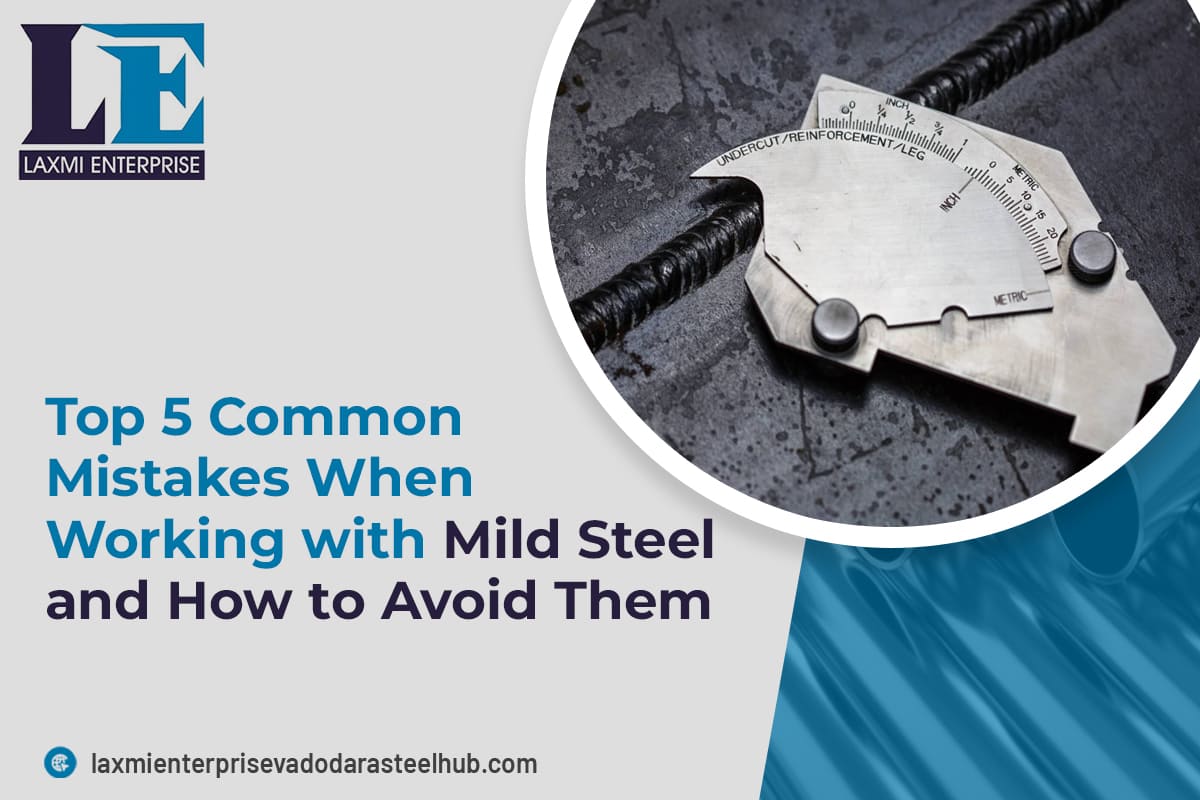
Top 5 Common Mistakes When Working with Mild Steel and How to Avoid Them

Mild steel is a popular choice for industrialists in manufacturing steel articles and machines.  It is widely used in fabrication due to its unparalleled flexibility, strength, and affordability. MS steel is used across various industries, including construction, furniture, plumbing, transport, and infrastructure. Although it is very easy to work with MS steel pipes, MS sheets, MS beams, etc, they require adequate conditions and prerequisites to work with. For desired results, focus on the crucial points about the top 5 common mistakes when working with mild steel and how to avoid them. 

Overview: MS Steel

MS steel stands for mild steel, a type of steel with low carbon content (0.05% to 0.25%). It has many attractive features, such as high formability, easy weldability, and machinability, making it a versatile material for various applications. It has low carbon content; therefore, it can be easily welded and bent without cracking. The word “mild” may mislead people into thinking it is a weak type of steel, but it has high tensile strength and resists corrosion to a high extent. 

These qualities help in providing support and rigidity to the structure. Therefore, MS steel has applications in the automotive industry, construction, fabrication, and machinery, among other sectors. Looking to purchase MS steel products for your application? Contact the most trusted MS steel product supplier in Vadodara, Laxmi Enterprise. We source our steel from certified vendors that conduct stringent quality checks on their products and then supply it to our clients with all the customisations mentioned. Interested? Give us a call to discuss further. 

Top 5 Common Mistakes When Working with Mild Steel and How to Avoid Them

  • Choosing the Wrong Variant: The MS steel products come in various shapes, sizes, and thicknesses. It depends on the application purpose to decide among all the varying types. For example, your MS plates are thick and stronger, but the MS sheets are much thinner and weaker than the MS plates. Therefore, you need to deeply assess the qualities before purchasing and avoid choosing the wrong variant.
  • Not Protecting Mild Steel From Corrosion: This measure is crucial when working with outdoor applications of MS steel, such as MS beams, MS channels, MS pipes, etc. Environmental impacts can have strong effects on the steel and erode it over time. To prevent corrosion, apply protective coatings like zinc or powder coating. 
  • Improper Storage and Handling: To avoid warping, bending, and rusting of your steel products, store them properly. Keep them in a dry, moisture-free place. While transporting big pipes and beams, arrange a big vehicle to prevent bending.   
  • Incorrect Cutting and Bending Techniques: If the cutting is not performed by professionals, it may lead to uneven parts and damaged material. Therefore, make sure to use a suitable steel cutting method like CNC cutting, laser cutting, hot bending, cool bending, etc.   
  • Used Improper Welding Technique: Welding is a crucial step in steel fabrication. Here, the two metal pieces are joined together to maintain strength. However, wrong welding techniques can leave the metal cracked and weak. To avoid this result, use the method based on thickness and type of mild steel. Always clean the steel surface before welding, as dirt and dust can lead to weaker joints.

Conclusion

Mild steel is a versatile metal and can be used in numerous industries for varying purposes. From furniture, toys, utensils, to large machines, everything can be made using mild steel. To ensure top-quality, purchase mild steel articles from Laxmi Enterprise, a renowned and trusted supplier of MS steel in Vadodara.  We source our steel from verified vendors and refine it at our facility. We ensure that our products are long-lasting, high-performing, and durable. Our range consists of MS sheets, MS beams, MS bars, MS TMT bars, MS channels, etc. Call us to place an order now!

Read More:–  Benefits of Using Colour Coated Sheets for Your Roofing!

Categories
MS Steel

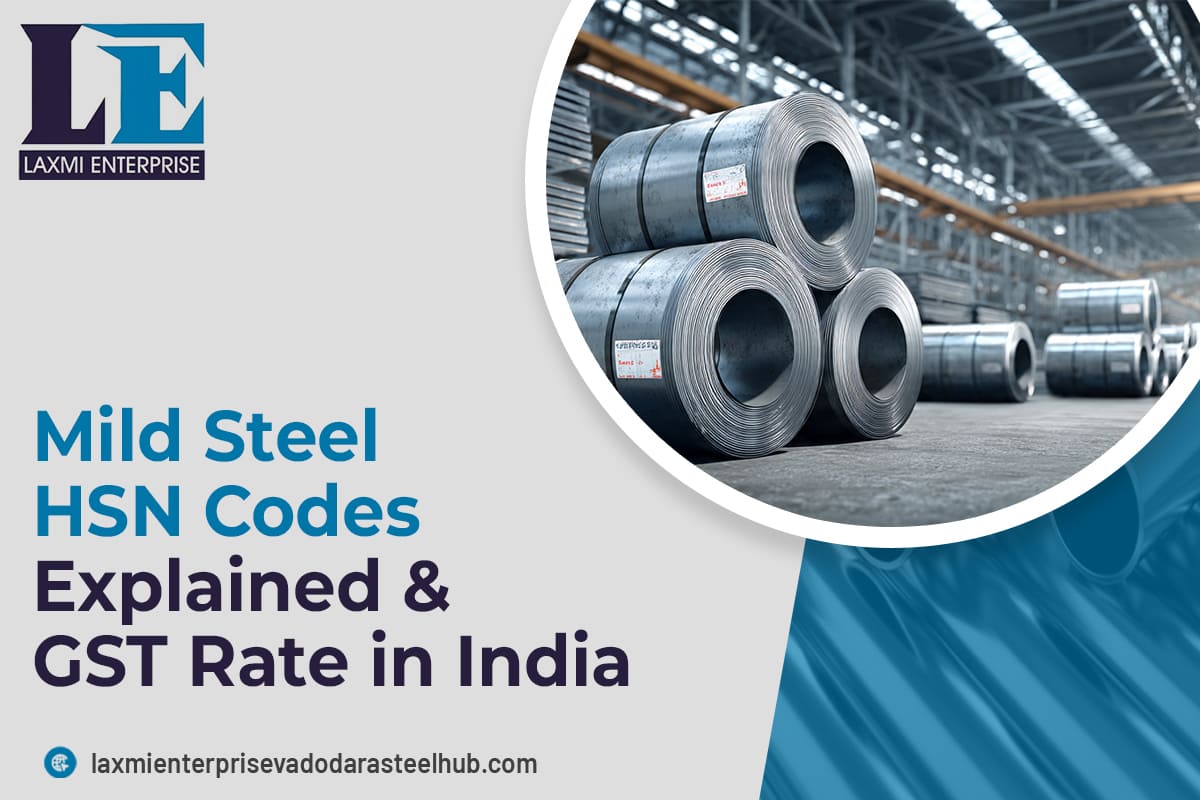
Mild Steel HSN Codes Explained & GST Rate in India

Mild steel is a type of steel made with low-carbon content. It is a very popular raw material across various industries, such as construction, industries, heavy industries, and fabrication. It has many attractive key features, such as being very malleable, ductile, offering high tensile strength, resistance to corrosion, and durability. These things make it a top choice for people associated with manufacturing. However, it is important to be aware of their feasibility. To help you make an informed decision about their cost, we will discuss the MS plate HSN code and the MS plate GST rate in India in this blog.   

What is the Mild Steel HSN Code

The MS plates are highly in demand and used in a variety of industries. Therefore, they fall in the scope of supply under the GST law and are taxable. There is no exemption available for MS plates under the GST law. Currently, the GST rate of 18% applies to the supply of MS plates. For fair prices and a transparent billing process, contact Laxmi Enterprise. Being a trusted MS steel product supplier in Vadodara, with years of legacy, we provide the highest-quality MS plates. We source our raw materials from certified vendors, refine them at our own facility, and export to our customers. For bulk orders of MS products, call us!  

What are the Applications of Mild Steel

  1. Making the structural framework for buildings, bridges, warehouses, and railway stations. 
  2. MS steel plates are used to make storage tanks, machinery parts, automotive chassis, and frames.  
  3. They are also used for oil drilling, cutting, and forming into specific shapes. 

MS Plates HSN Code and GST Rate in India

Mild steel plates fall under chapter 72 of the HSN (Harmonized System of Nomenclature), which covers steel and iron products. In this, MS plates are classified under HSN code 7208 or 7209, depending upon the process of their production: hot-rolled or cold-rolled. 

Under the GST regime in India, MS plates attract the GST rate of 18%, which includes 9% CGST/SGST or 18% IGST. The applicable GST rate remains the same regardless of the end use. Correct classification of MS plates under the appropriate HSN code is crucial for accurate GST invoicing, compliance, and input tax credit claims.

MS Product HSN Code and GST Applicable

Mild Steel ProductHSN CodeDescriptionGST Rate
Mild Steel Bars & Rods7214/ 7215Solid MS bars are used in construction and fabrication18%
Mild Steel Angles, Channels & Sections7216Structural MS items like angles, MS channels, and beams18%
Mild Steel Plates & Sheets (Hot Rolled)7208Thick MS sheets are used in industrial applications18%
Mild Steel Sheets & Coils (Cold Rolled)7209Smooth finish MS sheets for precision work18%
Mild Steel Pipes & Tubes (Welded)7306MS pipes are used for water, gas, and fabrication18%
Mild Steel Pipes & Tubes (Seamless)7304High-strength MS pipes without welding joints18%
Mild Steel Wire7217Mild steel wire for binding, fencing, and manufacturing18%
Mild Steel Flats7215Flat MS strips are used in frames and supports18%
Mild Steel Scrap7204Recyclable MS waste material18%
Fabricated Mild Steel Products7326MS items made after cutting, bending, and welding18%

Conclusion

Understanding the mild steel HSN code applicability and GST rates for MS plates is essential for smooth business operations and statutory compliance. Accurate classifications under the appropriate HSN category help in avoiding penalties ensures accurate input tax credit claims, and helps avoiding invoicing errors. Laxmi Enterprise is the largest MS plate supplier in Vadodara, which is also a testament to truthful invoice filing and compliance with tax regulations. We supply MS plates, MS beams, MS channels, and MS TMT bars. Call us to enquire about the products.

Frequently Asked Questions (FAQs)

The mild steel plate falls under the HSN code 72082510.

The HSN code 998313 falls under the information technology consulting and support services.

The HSN code might vary by country. The main code of 7208 remains the same, but different countries might add extra digits to it.

Yes, the World Customs Organization (WCO) updates the HSN system every five years.

Categories
MS Steel

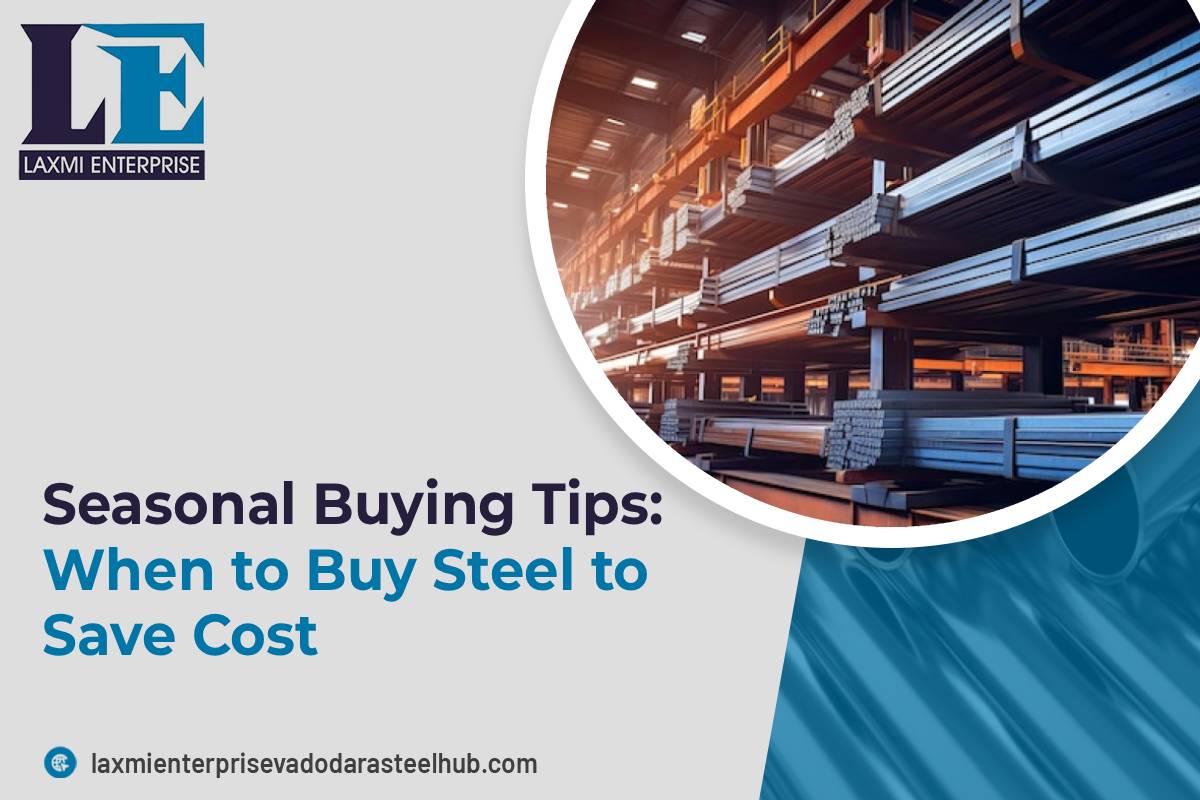
Seasonal Buying Tips: When to Buy Steel to Save Cost

Steel is a foundational raw material for industries such as construction, infrastructure, manufacturing, and fabrication. Yet, the price of these steel products doesn’t stay static for the whole year; they keep fluctuating. It fluctuates with seasonal demand, supply dynamics, weather cycles, and broader market forces. If you are looking to buy steel, then this guide can help you reduce costs significantly and sharpen your competitive edge. In this blog, we will take you through seasonal buying tips, shedding light on when to buy steel to save costs. 

Important Features and Applications of Steel

Steel is a top choice because it balances strength, flexibility, and long-lasting reliability. It can support heavy loads, endure tough conditions, and handle constant use. At the same time, it is easy to shape and work with. From large infrastructure projects to everyday items, steel plays an important role in modern life. Its durability, versatility, and recyclability make it a smart and sustainable option for many industries. If you are looking for high-quality steel from a renowned MS Steel Supplier in Vadodara, contact Laxmi Enterprise. We are a trusted brand for mild steel products such as MS channels, MS beams, MS pipes, MS bars, etc. Interested? Call to place the order. We are delighted to help you choose the best products at reasonable prices. 

Important Steel Features

  • It supports heavy loads without bending or breaking. 
  • It performs well under stress, impact, and extreme temperatures. 
  • It can be bent, rolled, and shaped without cracking. 
  • It is easy to join and fabricate into complex structures. 
  • It can be improved with coatings or alloying. 
  • It has a long service life with minimal maintenance. 
  • It is 100% recyclable, supporting sustainable practices. 

Common Applications of Steel

  • Construction and Infrastructure: Beams, columns, TMT bars, bridges, and pipelines 
  • Automotive and Transportation: Vehicle frames, body panels, railways, and ships 
  • Industrial Machinery: Manufacturing equipment, tools, and heavy machines 
  • Oil and Gas Sector: Storage tanks, drilling equipment, and transmission pipes 
  • Household and Commercial Use: Appliances, furniture, and everyday hardware

Seasonal Buying Tips to Purchase High-quality Steel

#1 Know the Seasonal Price Cycles

The steel mainly follows a predictable seasonal demand pattern, such as 

➤ High demand season: Spring and pre-monsoon months that see intense construction activity. This period sees a surge in demand and price of steel. 

➤ Low demand season: Mid-winter and heavy rain periods generally see lower demand, giving buyers an advantageous price.

#2 Best Time of the Year to Buy Steel

➤ Mid-winter (Dec–Feb)

  • Slow construction activity.
  • Suppliers clear inventory at competitive rates. 
  • Good opportunity for bulk stocking.

➤ Post-monsoon slowdown (Oct–Nov)

  • Demand eases after seasonal peaks.
  • A transitional trough before the year-end project starts.

➤ Late monsoon to early winter (Aug–Oct)

  • Prices are moderate — not steep like peak seasons.
  • Useful window to plan for early-year project starts. 

#3 Use Forward Buying to Lock in Lower Prices

Purchasing steel before the price-surging period is the best time to get the most attractive deals. This way, the customer can improve budget predictability and improve financial planning. It helps in securing deals ahead of competitors.

#4 Diversify Suppliers to Hedge Price Risk

Relying on a single supplier increases exposure to price spikes or delivery delays. It benefits the customer in exploring different inventories of different suppliers, helps get through the local price pressures, and the regular comparison strengthens negotiation leverage.

#5 Monitor Prices in Real Time

Seasonal tips become much more effective when paired with real-time price tracking. 

  • Use digital tools to monitor supplier rate changes.
  • Subscribe to alerts on raw material or freight cost movements.
  • Keep current on policy changes or tariff announcements that affect steel pricing. Real-time monitoring turns pricing data into actionable buying signals.

#6 Negotiate for Better Deals

Low-demand periods are ideal for negotiation, as suppliers are more open to offering bulk purchase discounts, flexible delivery schedules, and favorable payment terms. Taking advantage of these quieter market phases can significantly reduce overall steel procurement costs.

Conclusion

Smart steel buying depends on timing and planning. Understanding seasonal demand patterns helps buyers avoid peak prices and secure better deals. By purchasing during low-demand periods and negotiating effectively, businesses can control costs and improve procurement efficiency. For better deals, contact Laxmi Enterprise. We are the most trusted suppliers of MS Steel Vadodara. We source our steel from trusted vendors who comply with the steel standards set by the country, and then refine it further at our facility to meet the customer demands. If you are interested in our products, give us a call. 

Also Check: Role of Steel in Renewable Energy Projects

Frequently Asked Questions (FAQs)

Steel prices are generally lower during low-demand periods such as winter and post-monsoon months, when construction activity slows down.

Seasonal demand, weather conditions, and construction cycles influence steel consumption, causing prices to rise during peak seasons and soften during slower periods.

Yes, buying in bulk during off-peak seasons often allows buyers to negotiate better prices, flexible delivery terms, and improved payment conditions.

Categories
MS Steel

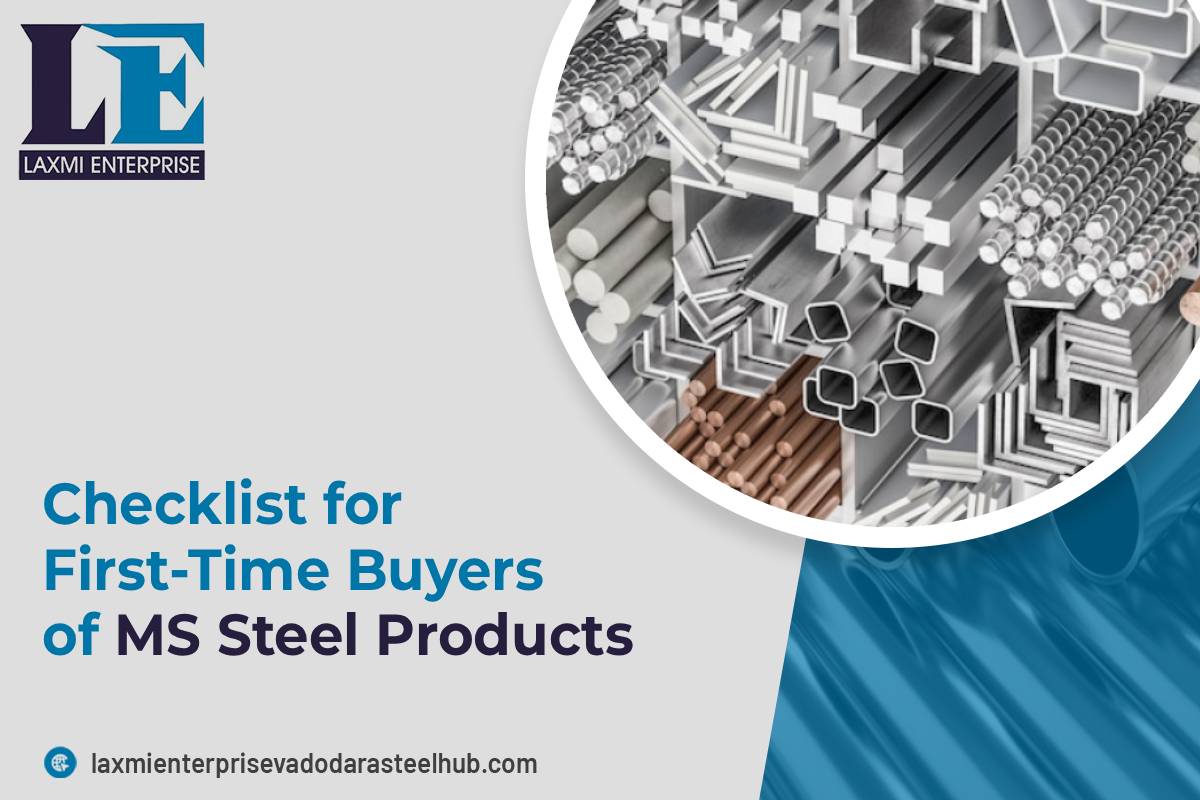
Checklist for First-Time Buyers of MS Steel Products

Mild steel is one of the most widely used metals in modern construction, fabrication, and manufacturing. It offers reliability, strength, and affordability makes it ideal for roofing, frameworks, heavy-duty machinery, and architectural structures. However, for such tasks, the user needs to understand how to choose the right type of MS steel application-specific products. This checklist for first-time buyers of MS steel products can save time and money while ensuring vital long-term performance. 

Overview of Mild Steel

Mild steel is a popular low-carbon alloy with a very small percentage of carbon, of around 0.5% to 0.25%. Laxmi Enterprise is a reputed and renowned supplier of MS steel product in Vadodara. We have a broad range of MS products: MS channels, MS bars, MS TMT bars, MS pipes, MS sheets, etc. You can purchase these products at very affordable rates. Give us a call.  There are many benefits associated with mild steel, such as 

  • The low percentage of carbon makes it highly malleable and strong.  
  • It is also considerably cheaper, easy to work with, easy to cut, shape, weld, and drill. 
  • It can be hot-rolled, cold-rolled, or galvanised based on the application and purpose. 
  • It is compatible with most of the coatings, such as paints, powder, zinc, and extends the lifespan in the external environment. 

Chemical Properties of Mild Steel

Properties 

Significance 

Base Composition

Primarily iron with carbon as the main strengthening element

Alloying Elements

Small amounts of manganese, silicon, sulphur, and phosphorus

Purpose of Additives

Improve toughness, deoxidation, machinability, and workability

Density

~7.85 g/cm³

Melting Point

1,425°C – 1,530°C

Mechanical Strength

Good tensile and fatigue strength under static and dynamic loads

Machinability

Excellent; easy to cut, drill, bend, and shape

Weldability & Forming

Thermally stable and well-suited for welding and high-temperature forming

Magnetic Properties

Magnetic and electrically conductive

Common Applications

Motor housings, fixtures, electrical, and industrial components

Carbon Content

Low carbon prevents brittleness and cracking during fabrication

Corrosion Resistance

Poor; requires painting, plating, or galvanising for outdoor use

Some of the Common MS Steel Products

  • Box Section: These hollow and strong profiles are perfect for framework, gates, handrails, columns, and fabrication works. 
  • Flat Bar: These are multi-purpose bars used for brackets, repairs, stiffeners, and reinforcement across construction and domestic projects. 
  • Angle Bar: It provides rigidity and corner strength for roof trusses, frames, and load-bearing supports. 
  • Channel & Beam: It is designed for structural frameworks, joists, and industrial builds requiring high load tolerance. 
  • Sheet & Plate: It is used in cladding, panelling, roofing, baseplates, and fabrication works. 
  • Round & Square: Our MS square & MS rectangular tube in Vadodara is common in manufacturing, machinery, and decorative metalwork applications. 

Advantages of MS Steel Products

  1. Excellent affordability 
  2. Easy to work with 
  3. Readily available 
  4. Strong and dependable 
  5. Highly weldable and formable 
  6. Fully recyclable 
  7. Accepts protective coatings

Disadvantages of MS Steel Products

  1. It requires a protective coating for outdoor purposes. 
  2. It has less surface hardness and is less resistant to wear compared to high-carbon steel.  
  3. It is unsuitable for high-temperature applications. 
  4. It should be handled with care to prevent dents or scratches.

How To Choose The Best Mild Steel Product

  • Understanding your project’s needs, such as load, exposure conditions, budget, and finish, is the first step towards choosing the best mild steel product.
  • Opt for corrosion-protected grades, such as galvanized S275, which are essential for structural applications.
  • Determine if basic cold-rolled mild steel is sufficient for indoor or light-use applications.
  • Always buy from a reliable vendor that provides cut-to-size services, like Laxmi Enterprise, the MS Steel Supplier in Vadodara
  • Before placing your order, choose the appropriate length, thickness, diameter, and quantity.
  • To get an accurate quote and guarantee that the materials arrive ready to use, enter the precise dimensions.

Conclusion

For any project to be safe, long-lasting, and economical, the proper mild steel must be chosen. You can prevent material failure and needless costs by knowing your load requirements, environment, and finish requirements, as well as by choosing the right grade, dimensions, and vendors such as Laxmi Enterprise. We are the top company for MS steel Vadodara and provide high quality, dependability, and long-term performance, which are further guaranteed by sourcing from certified, reliable suppliers and confirming adherence to accepted standards. Give us a call to know more. 

Check: Role of Mild Steel in the Manufacturing of Furniture

Frequently Asked Questions (FAQs)

S275 is the most commonly used mild steel grade for general construction due to its good balance of strength, flexibility, and affordability.

Yes, galvanised mild steel is recommended for outdoor or exposed environments as it provides corrosion resistance and extends the lifespan of the material.

Certified suppliers ensure the steel meets required standards, provide test certificates for traceability, and offer accurate cutting and delivery services, reducing the risk of defects or project delays.

Categories
MS Steel

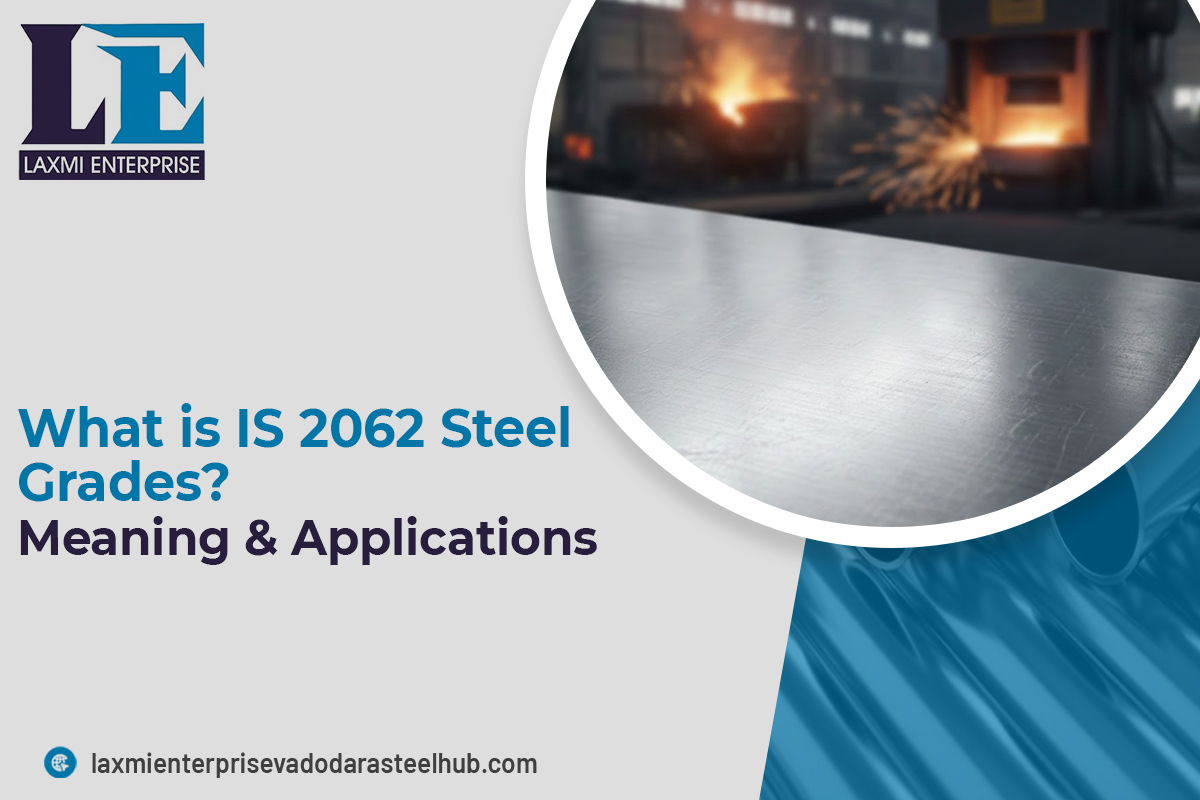
What is IS 2062 Steel Grades? Meaning & Applications

Steel plays a vital role in modern construction and fabrication, but not all steel is the same. One of the most commonly used structural steel standards in India is IS 2062. If you are involved in construction, engineering, or fabrication, understanding IS 2062 steel grades helps you select the right material for strength, durability, and safety. 

What is IS 2062 Steel?

IS 2062 is an Indian Standard specification for hot-rolled medium and high tensile structural steel. It defines the chemical composition and mechanical properties required for structural steel used in construction and engineering.

In simple terms, IS 2062 ensures that the steel you use has:

  • Proper strength
  • Controlled chemical composition
  • Reliable performance under load
  • Consistent quality

This standard is widely used for structural mild steel products such as beams, plates, angles, channels, and flats. For construction firms, it is crucial to use top-quality steel for their projects. Businesses looking for reliable structural materials often depend on a trusted MS steel product supplier in Vadodara to ensure quality-certified steel that meets IS standards. Laxmi Enterprise is known for supplying premium-grade structural steel suitable for residential, commercial, and industrial applications.


Is IS 2062 Mild Steel?

Yes, IS 2062 is considered a structural mild steel standard. Mild steel typically contains a low percentage of carbon, making it:

  • Easy to weld
  • Easy to fabricate
  • Ductile and flexible
  • Cost-effective

Because of these properties, IS 2062 grade steel is ideal for structural frameworks, bridges, buildings, and machinery platforms.

Common IS 2062 Steel Grades Explained

IS 2062 steel comes in different grades based on strength levels. The most common grades include:

#1 IS 2062 E250 (Fe 410)

  • Yield Strength: 250 MPa
  • Used in general structural applications
  • Suitable for residential buildings and light industrial structures

This is one of the most widely used grades in construction.

#2 IS 2062 E350 (Fe 490)

  • Higher yield strength than E250
  • Used in heavy structural projects
  • Ideal for industrial sheds and load-bearing frameworks

This grade offers better resistance to stress and heavy loads.

#3 IS 2062 E410 / E450

  • High tensile strength
  • Used in heavy-duty industrial construction
  • Suitable for bridges, large infrastructure, and heavy fabrication

These grades are selected where maximum structural strength is required.

Chemical Composition of IS 2062 Steel

The strength and performance of IS 2062 steel depend on its chemical composition. It typically contains:

  • Carbon (C) – Provides strength
  • Manganese (Mn) – Improves toughness
  • Silicon (Si) – Enhances durability
  • Sulphur (S) & Phosphorus (P) – Controlled within limits for quality

Low carbon content ensures that the steel remains weldable and easy to fabricate.

Applications of IS 2062 Steel

IS 2062 steel is widely used across multiple industries due to its versatility.

#1 Building Construction

  • Structural frames
  • Columns and beams
  • Platforms
  • Roof supports

Many contractors prefer sourcing MS Steel Vadodara materials from reliable suppliers to ensure compliance with structural standards.

#2 Industrial Sheds & Warehouses

Industrial buildings require strong steel capable of supporting heavy machinery and large spans. Grades like E350 are commonly used in these applications.

#3 Fabrication & Engineering Projects

IS 2062 steel is also used in:

  • Machinery components
  • Fabricated structures
  • MS plates and flats
  • Equipment bases

Builders often rely on a dependable mild steel flat bar supplier in Vadodara like Laxmi Enterprise  to source quality flat bars used in fabrication work.

#4 Bridges and Infrastructure

Higher grades like E410 and E450 are used in:

  • Bridges
  • Flyovers
  • Large infrastructure projects

These applications require steel that meets strict strength and safety standards.

Why Choosing the Right Grade Matters

Selecting the correct IS 2062 grade ensures:

  • Structural safety
  • Long-term durability
  • Cost efficiency
  • Compliance with engineering standards

Using the wrong grade can lead to structural failure or increased maintenance costs. That’s why consulting experienced suppliers and engineers is essential before finalizing material selection.

Conclusion

IS 2062 steel grades play a critical role in ensuring structural strength and safety in construction and industrial projects. As a structural mild steel standard, it offers reliability, durability, and flexibility for a wide range of applications. Understanding the differences between grades like E250, E350, and E410 helps you make informed decisions for your project. At Laxmi Enterprise, Vadodara, we specialize in supplying high-quality IS 2062 structural steel products for residential, commercial, and industrial projects. From MS beams and channels to plates and flat bars, we provide materials that meet industry standards and performance expectations. Contact Laxmi Enterprise today for bulk orders and expert consultation.

Read: Mild Steel HSN Codes Explained & GST Rate in India

Frequently Asked Questions (FAQs)

IS 2062 is an Indian Standard specification for structural mild steel used in construction and engineering.

Yes, grades like E250 are commonly used in residential buildings.

E350 has higher yield strength and is used for heavier structural applications compared to E250.

Yes, due to its low carbon content, it offers good weldability.

It is used in buildings, bridges, industrial sheds, platforms, and fabrication projects.

Selection depends on load requirements, structural design, and project type. Consult your engineer or supplier for guidance.

Categories
MS Steel

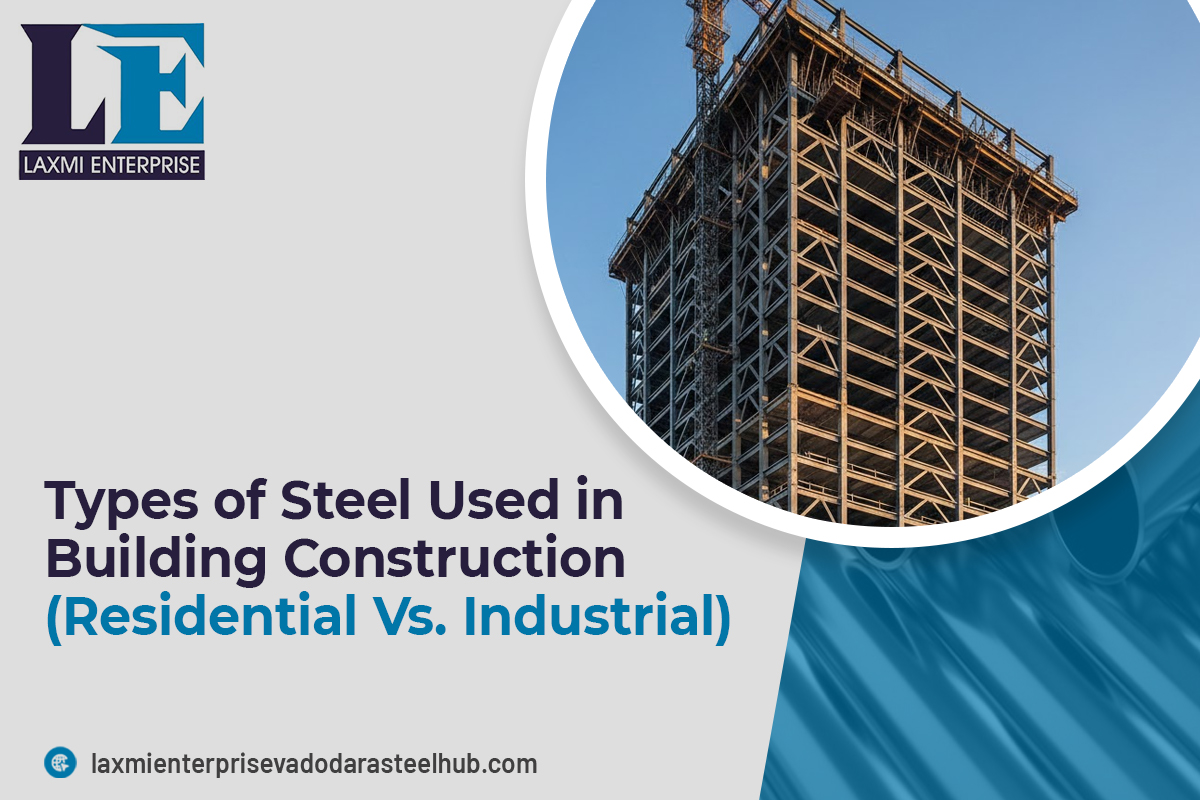
Types of Steel Used in Building Construction (Residential Vs. Industrial)

Steel is the backbone of modern construction. From small residential homes to massive industrial factories, different types of steel are used depending on strength, durability, and load requirements. Understanding the difference between residential and industrial steel helps builders, contractors, and property owners make smarter material choices. So let’s get started! 

Why Steel Is Essential in Construction

Steel is widely used because of its:

  • High tensile strength
  • Durability and long lifespan
  • Resistance to fire and environmental stress
  • Flexibility in design
  • Cost-effectiveness over time

However, not all steel is the same. The type used in a residential house differs significantly from what is required in industrial buildings.

Steel Used in Residential Construction

Residential buildings typically include houses, apartments, villas, and small commercial spaces. These structures require steel that provides strength while maintaining cost efficiency.

#1 TMT Bars (Thermo-Mechanically Treated Bars)

TMT bars are the most common steel product used in residential construction. They are mainly used for reinforcement in:

  • Foundations
  • Columns
  • Slabs
  • Beams

TMT bars offer high strength and flexibility, which helps buildings withstand earthquakes and structural stress. For homes and small buildings, medium-grade TMT bars are generally sufficient. If you are planning a project, working with a trusted TMT bar supplier in Vadodara, like Laxmi Enterprise, ensures you get quality-certified materials suited for both residential and industrial needs. Choosing the right supplier is just as important as choosing the right steel.

#2 Mild Steel (MS) Sections

Mild steel is commonly used in:

  • Window grills
  • Gates
  • Stair railings
  • Small structural supports

MS sections are easy to fabricate and weld, making them ideal for residential construction.

#3 MS Channels and Angles

Structural elements like ISMC MS channel in Vadodara are widely used in small framing structures, roof supports, and lintel beams. These channels provide additional support without adding excessive weight to the structure.

Steel Used in Industrial Construction

Industrial construction includes factories, warehouses, power plants, refineries, and large commercial complexes. These structures require heavy-duty steel capable of handling high loads and stress.

#1 Structural Steel Beams

Industrial buildings rely heavily on I-beams and H-beams for load-bearing frameworks. These beams support:

  • Large roof spans
  • Heavy machinery loads
  • Multi-level platforms

Working with experienced steel beam suppliers in Vadodara, like Laxmi Enterprise, ensures access to properly graded and tested beams for industrial safety standards.

#2 Heavy-Duty TMT Bars

Unlike residential buildings, industrial structures often require higher-grade TMT bars for:

  • Thick foundations
  • Machinery platforms
  • High-load columns

These bars provide superior tensile strength and durability.

#3 MS Plates and Heavy Sections

Industrial construction also uses:

  • Thick MS plates
  • Heavy channels
  • Structural steel columns

These materials support large-scale operations and dynamic loads that residential buildings typically do not experience.

Residential vs Industrial Steel: Key Differences

table

Industrial steel must meet stricter safety and engineering standards due to the higher risk and load factors involved.

How to Choose the Right Steel for Your Project

When selecting steel, consider:

  1. Load Requirements: Residential projects require moderate strength, while industrial projects demand high load-bearing capacity.
  2. Budget: Industrial-grade steel is more expensive due to higher thickness and strength.
  3. Building Type: A warehouse requires different structural support compared to a home.
  4. Compliance with Standards: Always ensure steel meets IS standards for quality assurance.

Understanding the types of steel used in building construction helps ensure structural safety and durability. Residential projects require cost-effective and moderate-strength steel, while industrial projects demand heavy-duty structural materials capable of handling extreme loads. For high-quality mild steel products tailored to both residential and industrial projects, trust Laxmi Enterprise- the best MS Steel Supplier in Vadodara. We supply premium TMT bars, MS channels, structural steel beams, and more – all meeting industry standards. Contact us today for bulk orders and expert consultation.

Read: Top Mild Steel Products to Use in Indian Construction Projects in 2026

Frequently Asked Questions (FAQs)

TMT bars and mild steel sections are most commonly used for residential construction.

Industrial buildings carry heavier loads and machinery, requiring higher-grade structural steel.

It is not recommended, as residential steel may not meet industrial load and safety requirements.

MS channels are used for framing, structural support, and roof reinforcement.

Always purchase from trusted suppliers who provide IS-certified materials.

Yes, TMT bars are essential for reinforcing concrete in foundations and slabs.

Categories
MS Steel

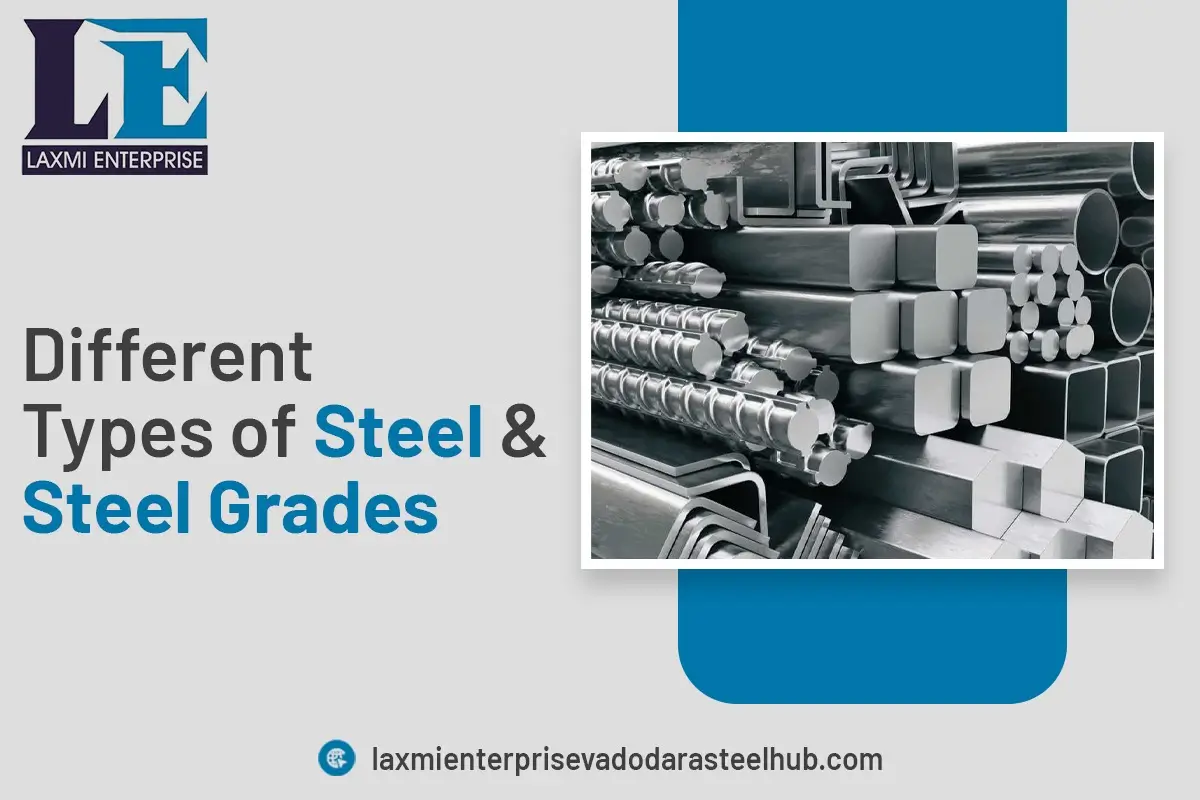
Different Types of Steel & Steel Grades

Steel is considered as the backbone of industries. Its versatility, impressive tensile strength, and durability make it an indispensable material for construction, manufacturing, engineering, and related fields. Steel is mainly composed of iron and carbon. Its properties vary depending on treatment, composition, and process. This results in four types of steel that serve its purpose. In this blog, we explore the different types of steel, grades, and the role it plays in various industries. 

What is Steel Composed of?

Steel is a material that is basically made of iron (Fe) and Carbon (C). However, it is crucial to note that modern steel is more versatile and complex. Steel is an alloy type of material, as iron is a metallic material, and carbon is a non-metallic material. The carbon content can vary and can be upto 2%. By increasing the carbon content, it can make the steel brittle.

4 Types of Steel

The four types of steel are classified into 4 groups viz Carbon Steel, Alloy Steel, and Stainless Steel and Tool Steel. 

#1 Carbon Steel

Carbon is one of the most common types of steel. It consists of traces of elements apart from carbon and iron. It is classified into three groups based on the carbon content: 

  • Low carbon steel or mild steel (Carbon content up 0.3%)
  • Medium carbon steel ( Carbon content between 0.3 to 0.6%)
  • High carbon steel (Carbon content more than 0.6%) 

Laxmi Enterprise is a leading MS steel supplier in Vadodara. We specialize in supplying top-quality low-carbon steel products like MS pipes, MS channels, MS angles, MS TMT bars, roofing material, and much more. Contact us for the best quotes.

#2 Alloy Steel

This type of steel is made by mixing steel with other alloying components like nickel, chromium, or copper. This allows the steel to exhibit superior tensile strength, anti-corrosion resistance, improved ductility, and machinability.

#3 Stainless Steel

Stainless steel comprises 10.5 to 20% chromium. The higher the chromium content the shinner are the finished products. This type of steel displays impressive resistance to corrosion and can withstand extreme weather conditions, making it ideal for outdoor applications.

#4 Tool Steel

Tool steel is specially designed for producing drilling and cutting equipment. This type of steel exhibits excellent wear resistance and can withstand high temperatures.

Types of Steel Grades

The steel grading system classifies steel based on case use. Two of the most common global steel grading systems are:

  • SAE/AISI Steel Grade: The Society of Automotive Engineers (SAE) and the American Iron and Steel Institute (AISI) provide four-digit codes to categorize steel based on its chemical composition and case use. 
  • ASTM Steel Grade: The American Society for Testing and Materials (ASTM) classifies steel based on its mechanical properties like durability, tensile strength, ductility, and other properties.

Conclusion

These steel grades are used by engineers, architects, and government agencies to ensure the consistency and quality of steel. The steel grades are standards to display the steel’s properties with specificialty to ensure precise processes and applications. Mild steel is one of the versatile, durable, and high-endurance types of steel. Laxmi Enterprise is a trusted MS steel product supplier in Vadodara. We offer a comprehensive range of MS products to cater to diverse requirements. Contact us to discuss your requirements further.

Categories
MS Steel

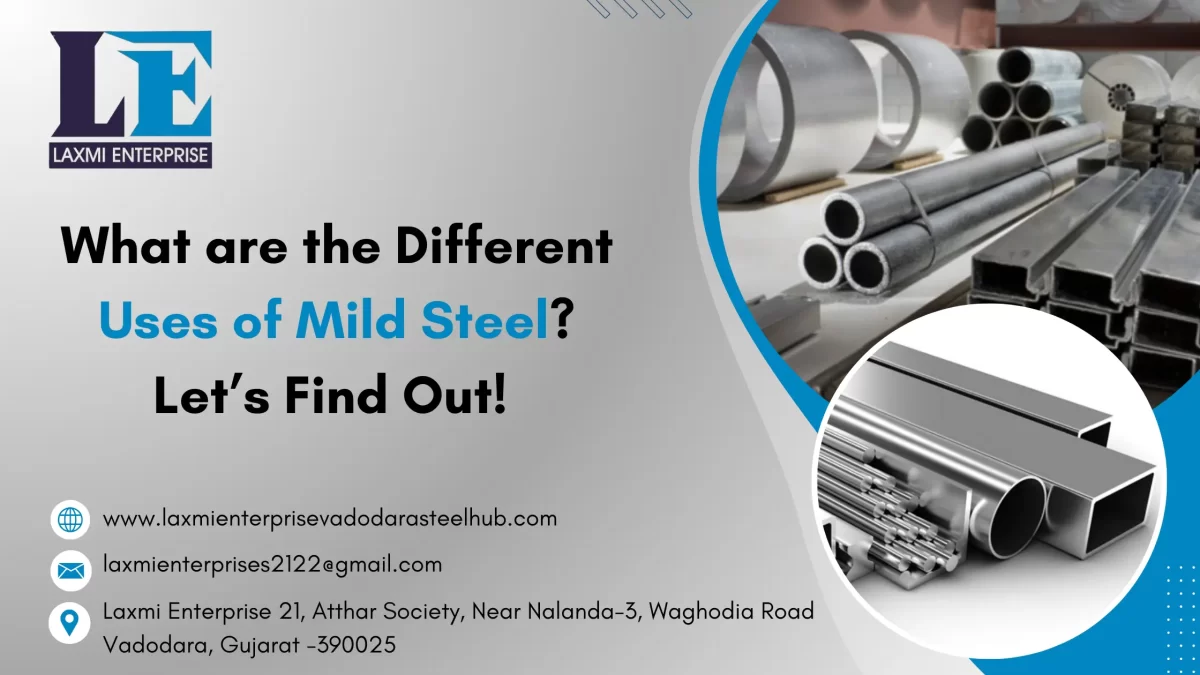
What are the Different Uses of Mild Steel? Let’s Find Out!

Steel is an essential material that finds applications in different industries. Mild steel, also known as low-carbon steel (carbon content 0.05 to 0.25%), is a popular type of steel due to its affordability. This cost-effective option, coupled with its versatility and ease of fabrication, makes it a top choice in many industries. So, what are the different uses of mild steel? Let’s find out! In this blog, we explore how MS steel is manufactured and its different uses, shedding light on its importance in different industries. 

How is Mild Steel Manufactured?

There are some steps that go into manufacturing MS steel: 

  • Primary Steelmaking: In this step, iron is mixed with coal and lime and later heated in a blast furnace. 
  • Secondary Steelmaking: In the secondary step, the carbon content is reduced to the desired content, and other alloying elements are added to improve the MS steel’s properties. Additionally, monitoring and controlling the heat treatment and cooling of the furnace are measured. 
  • Casting & Primary Forming: The steel in the furnace reaches the specific carbon content. This gives the MS steel mechanical properties, which are later poured into the mold. The liquid steel is given the desired shape and cut into small pieces. Laxmi Enterprise, an MS steel product supplier in Vadodara, provides a wide range of MS products sourced from the best steel companies in India. Our mild steel products exhibit excellent mechanical properties and are suitable for diverse applications. 
  • Secondary Forming: In this process, steel undergoes secondary formation processes such as CNC machining, where the steel is shaped using computer-controlled tools, case hardening, a heat treatment process that increases the surface hardness of the steel, and hot/cold rolling, a process that changes the thickness and shape of the steel.

What Are The Uses of Mild Steel?

Mild steel is highly versatile, offering a wide range of applications. Its ease of welding and low cost make it an ideal choice for various uses. Laxmi Enterprises offers a comprehensive range of MS products sourced by trusted steel companies.

 Here are Some of the Common Uses of Mild Steel: 

  • Construction: MS products exhibit tensile strength, making them perfect for various construction work. Their ability to withstand extreme weather conditions and resistance against corrosion allow for various construction structures. 
  • Machinery: Mild steel is ductile, strong, and durable, making it ideal for the production of machinery and equipment. Due to its low carbon content, this type of steel is easy to weld and fabricate to form desirable shapes. 
  • Pipeline: MS pipes are ideal for transporting water and gases. They were also used to manufacture agricultural equipment in the agricultural sector. 
  • Cookware: MS steel is used to manufacture knives and non-stick cookware. Its ability to withstand higher temperatures, anti-corrosion resistance and low-carbon content make it ideal for various cookwares. 

Conclusion

MS steel’s versatility makes it appropriate for construction, automotive, machinery, and other industries. Laxmi Enterprise is a leading MS plate supplier in Vadodara. We offer a comprehensive range of MS products, such as MS pipes, MS channels, MS TMT bars, MS chequered plates, MS beams, and more. Contact us for the best quotes.

laxmi enterprise vadodara steel hub Logo

We make it easy for our customers to order for any mildsteel material like pipe, channel, angle, beam, HR Sheet, CR sheet, TMT bars etc. We provide them according to their requirement at the best quality and cost also.

Get in touch

© 2026 Laxmi Enterprise | All Rights Reserved